
Of all the challenges the business world faces day after day, one of the most worrying today is, without a doubt, the lack of worker engagement. After all, this is a problem that affects not only companies’ productivity but also their bottom line: according to a survey by the American institute Gallup, the United States loses nearly 370 billion dollars a year because of unmotivated employees.
In a scenario like this, inaction is not an option. And one approach increasingly being taken to get around this situation is the adoption of gamification in the workplace.
In today’s article, we have selected 5 success stories that show how gamification techniques help boost the productivity and motivation of workers around the world.
Contents
- 1) Salesforce
- 2) McDonald’s
- 3) Microsoft
- 4) Google
- 5) Deloitte
- Overcoming challenges with gamification in the workplace
1) Salesforce
Working in sales is like riding a big roller coaster every day. There are moments of extreme enthusiasm, when everything seems prosperous and steady, and others of total demotivation.
Keeping the spark alive can be an almost impossible mission depending on the context and the moment, and that is where gamification elements can be extremely helpful. Rankings, competitions, and rewards are proven to be great sales motivators.
In addition, the sales field suffers from a severe shortage of good professionals. The gift of persuasion is hard to find and even harder to teach.
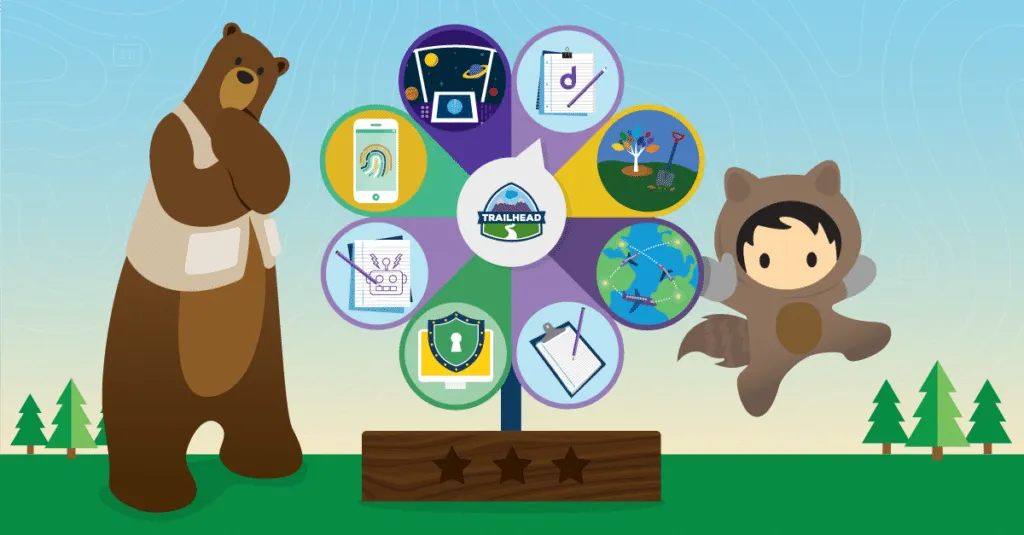
With all these challenges in mind, Salesforce created Trailhead, a fully gamified online learning platform that offers interactive training modules on the company’s products. Using typical gamification elements such as points, badges, and rankings, Trailhead has already driven more than 2 million professionals to want to learn more about their own craft and boost their careers.
2) McDonald’s
The fast-food giant McDonald’s has a long history with the world of video games. In the past, the characters that illustrated the chain’s commercials and restaurants even starred in their own games.
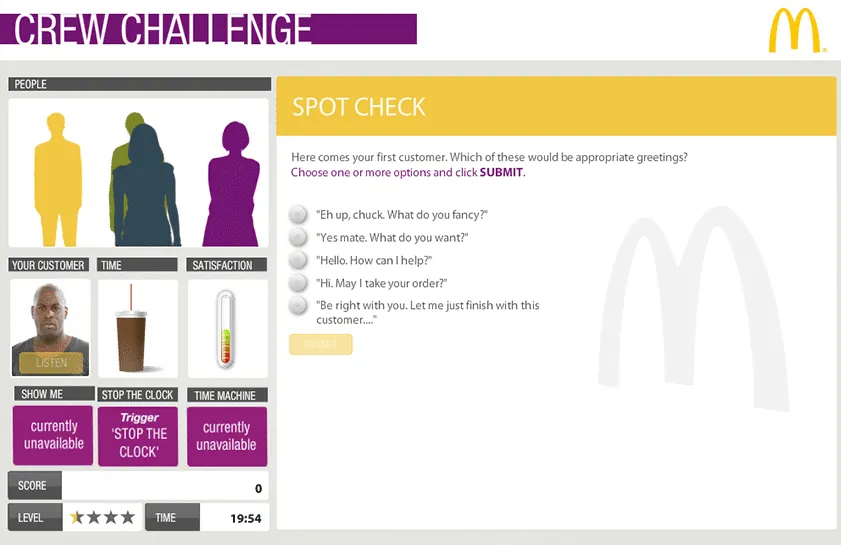
But nothing compares to the Till Training Game project, a gamified training program used to train the chain’s employees.
In an environment that simulates the process of taking orders and payments at a McDonalds restaurant, the Till Training Game uses elements such as points and “leveling up” to motivate employees to improve their performance and engagement at work.
And the numbers show the initiative worked, since the game recorded more than 500,000 downloads in its launch month alone. In addition, the platform has also helped increase customer satisfaction and employee retention.
3) Microsoft
Microsoft Office is a ubiquitous presence throughout the corporate world. Few companies do not use at least one of its tools. In job listings, the requirement “knowledge of the Office suite” is almost always present.
Given this scenario, it does not take much thought to conclude that learning to use Office is a basic requirement for any professional. And there is a far more stimulating way to do it than traditional courses and tutorials.
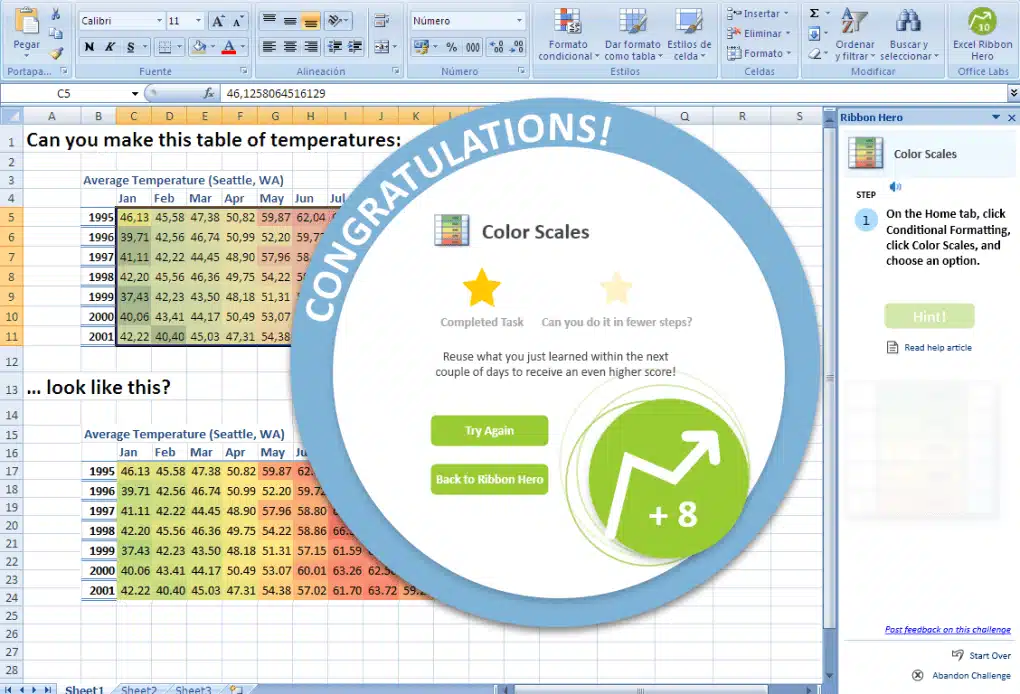
The training program Ribbon Hero is a platform that uses gamification to teach the main features and functionality of Microsoft Office. Through a series of challenges, users learn while being driven by rewards and by the sense of personal satisfaction that the language of games provides. It is no wonder that Ribbon Hero has been downloaded more than 1 million times.
4) Google
Preparation for the job market should begin long before entering it. With that in mind, Google developed Code-In, a programming competition for students aged 12 to 17 that was held annually between 2010 and 2019.
In the nearly 10 years the initiative ran, more than 10,000 students from more than 100 countries took part in a gamified tournament full of challenges aimed at developing their programming skills. The extra incentive came from accumulating points and the chance to climb the overall ranking. The result of it all? The world of programming was demystified for countless young people, and new talents in the computing world could be identified.
5) Deloitte

Developing new, good leaders is a fundamental initiative for securing the future of the business world. And gamification can also be an efficient ally in this process.
A very successful example is the Leadership Academy created by the auditing firm Deloitte. It is a gamified leadership development program that offers its participants simulations, assessments, and mentoring.
The entire training process takes place within a gamified environment full of triggers that awaken participants’ motivation. Since its launch, the Leadership Academy has attracted more than 100,000 participants in more than 160 countries, people who left the experience with broader expertise in skills such as leadership, collaboration, and innovation, on their way to a successful career as high-performing leaders.
Overcoming challenges with gamification in the workplace
As you have seen, gamification is a powerful tool for the professional environment. Through it, it is possible to tackle one of the most urgent and damaging challenges for companies, which is the workforce’s lack of motivation.
The big companies we mentioned here are just the tip of this great iceberg. The universe of gamification is as vast as an open-world game. And as good players, it is our mission to explore it and find our own path and success within it.
Adapted from: Level Up Your Workplace: 5 Inspiring Examples Of Gamification In Action