
Everyone who runs a business has found themselves, at one point or another, dealing with marketing questions.
Marketing is essential for any type of business, regardless of size or segment. And as much as the trends that emerge from time to time serve as guides, the truth is that developing a good marketing strategy is much more than following what is in fashion.
And in a reality where digital has made marketing even more competitive, massive, and aggressive, it is imperative to look for ways not to be just another face in the crowd. And gamification can be a great bet.
In today’s article, we will show how the strategies of games can merge with your company’s sales and promotion strategy. Ready to innovate?
Contents
- Gamification in marketing: what is it, anyway?
- Using the Octalysis Framework in marketing
- Gamification in marketing in practice
- Transforming a brand’s story with gamification
Gamification in marketing: what is it, anyway?
Applying the concepts of gamification to marketing has a very broad and deep meaning. However, we can sum it up as the creation of experiences and narratives that speak directly to the human psyche. It sounds complex, but it really is not.
If you are even minimally familiar with the concepts laid out by gamification expert Yu-kai Chou and his Octalysis Framework, you know that the main “magic” of gamification is that it works directly with the triggers and emotions that drive human behavior. It is the key to something extremely valuable to companies: solid customer loyalty and engagement.
Gamification is a unique differentiator when we talk about a scenario in which brands fight for attention at every moment. And this is made worse when we consider that consumers’ power of choice is much greater today than it was 20 years ago, for example.
Creating experiences, actions, and stories that make customers feel connected to the brand is essential to winning the public’s preference. Companies must keep in mind that today’s consumer is not a passive being who accepts what is offered without questioning or researching.
Another important point to stress is that gamification cannot look like a loose element within marketing. Its adoption must be completely aligned with the brand’s identity and message. It is not about gamifying for the sake of gamifying, but about identifying gamification elements that fit the journey the company wants to build for its customers.
In short, we can say that gamification in marketing basically consists of creating immersive, enjoyable, and meaningful experiences for the consumer. By tapping into the psychological triggers found in games, marketers can create campaigns that engage and build loyalty, profoundly transforming the customer-brand relationship.
Using the Octalysis Framework in marketing
For those who are not yet familiar with it, the Octalysis Framework is a methodology developed by gamification expert Yu-kai Chou, one of the world’s leading authorities on the subject.
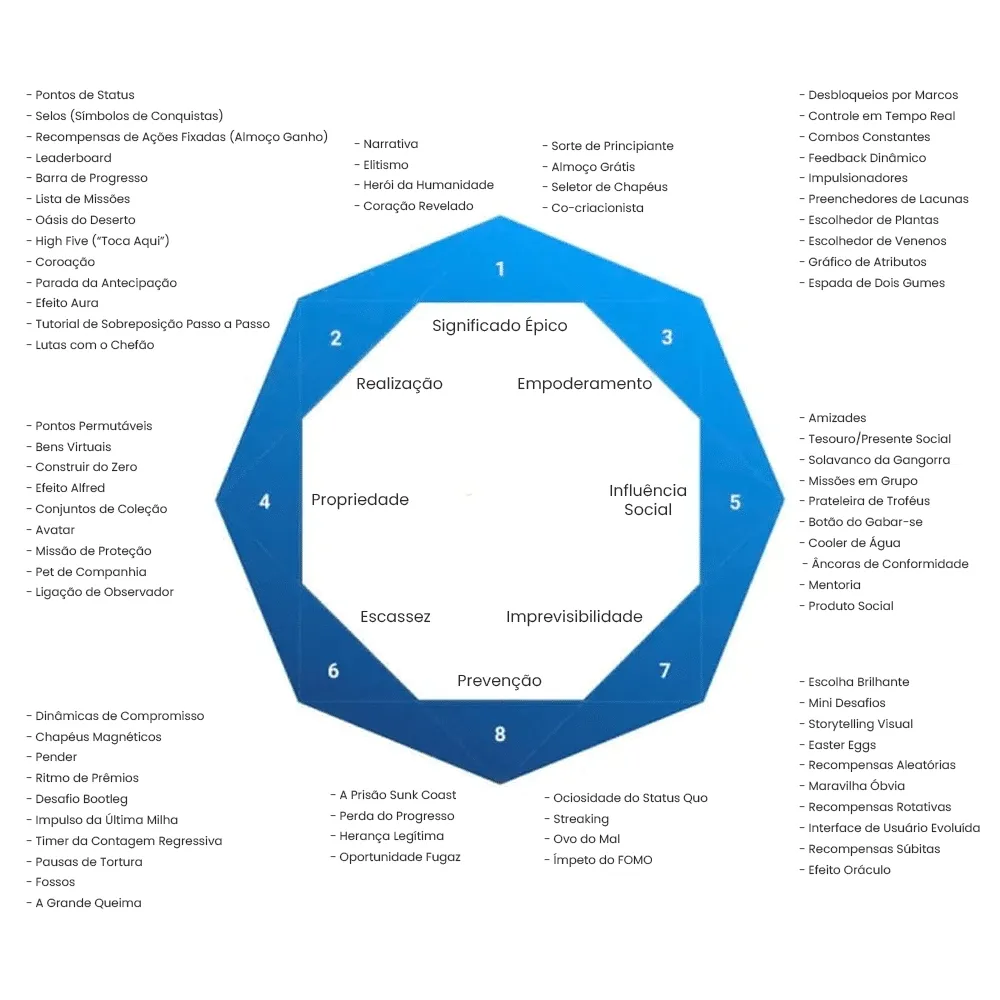
Adapted from: Yu-kai Chou
Developed after 17 years of research and study, the Octalysis Framework is depicted visually as an octagon in which each side represents what the author calls Core Drives, that is, the keys that awaken emotions and motivate human beings to take action, including buying something.
The first industry to master these Core Drives was precisely the games industry, and its success came to serve as a mirror for the rest of the market.
Understanding Octalysis is crucial to making sure gamification is applied to marketing the right way. The Core Drives serve as a guide for selecting the elements that will best match the audience and the intent of each campaign.
In a world where consumers are constantly bombarded with endless options, following the concepts of Octalysis may be the secret, if that word can be used in a context as broad as marketing, to creating actions that truly stand out from the rest of the crowd.
And if that alone is not enough to convince someone of the benefits gamification brings to marketing, it is always worth stressing that most of the companies that have done it saw a noticeable increase in their ROI, or return on investment. This is because gamification, when done right, can increase conversion volume, sales, and customer retention.
Gamification in marketing in practice
Now that you understand the principles of gamification set out by the Octalysis Framework, it is time to bring them into the world of marketing. And as you will see below, the range of possibilities is broad and diverse.
Challenges and missions
Source: Alta Comunicazione/Santa Helena
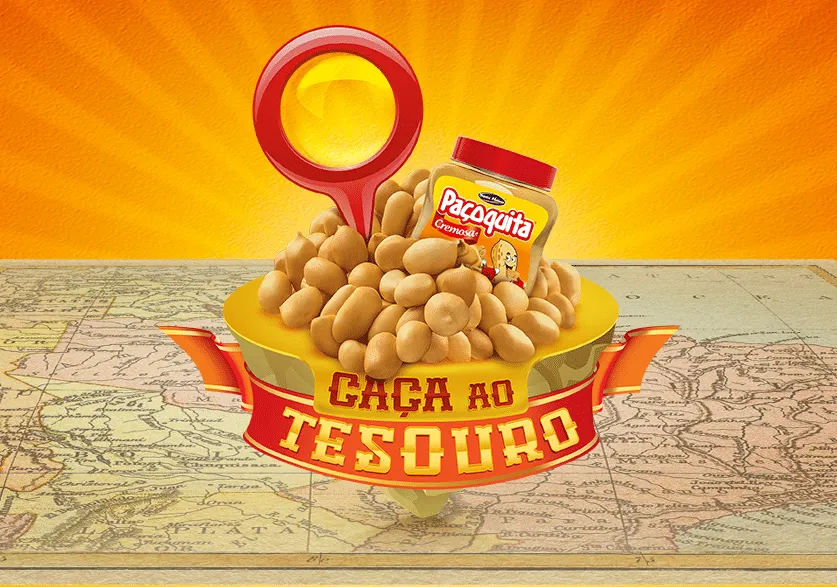
The year is 2014. Brazil’s largest peanut-based products company announces the launch of the creamy version of its flagship product, Paçoquita. The novelty causes a stir among lovers of the sweet, and a frantic search begins in supermarkets all over Brazil. Unable to meet all the demand, the manufacturer decides to turn the product’s scarcity into a marketing strategy. Thus begins the Paçoquita Cremosa Treasure Hunt, a campaign that turned the search for the new product into a mission worthy of the best adventure stories. The result of it all? Enormous buzz and a product that is still on the market today.
This case from a decade ago remains an excellent example of one of the most interesting gamification elements: missions and challenges that tap into the human desire to achieve things and overcome obstacles (in this case, getting hold of a jar of Paçoquita Cremosa and overcoming the obstacle of the product’s uneven initial distribution).
However, this is only one of the ways of applying this Core Drive in marketing campaigns. From simple tasks, such as opening a map to find where to buy a product, to complex missions full of stages, it all depends on the interests and motivations of the target audience.
Imagine this other example, this time hypothetical: a beverage company decides to launch a summer campaign that encourages customers to collect virtual points with every purchase. Later, those points can be exchanged for rewards such as discounts, limited editions, or even entry into a larger campaign.
Besides the obvious boost to sales, a strategy like this creates constant interaction between the brand and the customer. And this is the big secret to a long-lasting business relationship.
What is more, these gamified elements can help the company better understand the people who consume its product or service. By analyzing the response to and levels of participation in these challenges and missions, it is possible to collect key data to plan marketing campaigns with a better chance of hitting the target.
Progress and feedback
Growth markers, such as progress bars and levels, are very effective gamified elements when it comes to boosting user engagement and motivation.
The feeling of having achieved or accomplished something is an extremely strong motivator. When consumers feel they have a history with a brand, they tend to stay loyal and committed to it.

Progress bars are a particularly useful resource because they represent that feeling visually. A good example of their use is in e-commerce, which often implements them to show a customer’s progress in incentive and loyalty programs. On receiving this visual feedback, customers feel even more motivated to keep buying there to watch their bar fill up. A simple mental trigger, but one of proven effectiveness.
Levels, in turn, can be suited to segmenting customers based on their engagement and purchase histories. Applied to a loyalty program, for example, this system can provide a gamified experience in which new benefits are unlocked for the consumer with each level reached.
With these examples, it should be clear where the main advantage of these gamification elements in marketing lies: they encourage customers to buy more and make them loyal to the brand, product, service, or company.
Rewards and incentives
When we talk about applying gamification elements in marketing, we are talking about a strategic way of offering value that will resonate with customers and make them loyal to what they consume. And a great way to do this is by offering rewards and incentives.
In a gamification context, no reward is offered just for the sake of it, but as part of a carefully thought-out strategy to fulfill customers’ wants and needs.
The effectiveness of this strategy comes from the way it activates a series of emotional triggers, such as the desire for achievement, the pleasure of receiving a gift, and the feeling of being someone special for belonging to a specific group.

For example: by offering exclusive content or early access to certain products, the brand builds a relationship with the customer that goes beyond the simple commercial transaction. After all, the customer is, above all, a human being who likes to feel valued and special. The same happens when consumers are loyal to the brand and accumulate points for it: a sense of connection and recognition is awakened.
Social elements
Human beings are social by nature, and game developers understand this very well. That is why social elements are so important in the gamification process.

One of the best-known social elements of gamified methodologies is the use of rankings and leaderboards. They create a sense of healthy competition and motivate users to work hard to move up. A good example of applying this concept in a marketing context is fitness lifestyle apps that offer leaderboards where users can compare their performance with that of their colleagues and friends.
Collective challenges, which involve competitions or users working together toward a common goal, are also an interesting element to apply to gamification in marketing. They provide a sense of community and belonging that can be extremely motivating for a customer.
Simpler actions, such as sharing achievements on social media or inviting friends to try a service or product, can also be very useful for gauging customers’ behavior and preferences.
Transforming a brand's story with gamification
As you have seen, applying gamification in marketing is much more than simply dumping elements into a strategy at random. It is a total shift in the mindset and approach of the brand that wants to adopt it.
When used skillfully and professionally, the key elements of gamification can tell stories, personalize experiences, strengthen the power of choice, and surprise customers.
In today’s world, people do not simply look for products or services. They look for ideas, meanings, and concepts they identify with and feel part of. And gamification, with its elements that offer unique combinations of entertainment, engagement, value, and motivation, can be a great ally for businesses that want to adapt to these new times.
Adapted from: Discover the Power of Gamification Elements in Marketing Campaigns