
When Taiwanese entrepreneur Yu-kai Chou began studying gamification to create what would become his great legacy on the subject, the celebrated Octalysis Framework, one point soon caught his attention: while some games tend to experience huge spikes in popularity that soon fade, others manage to keep their fame steady for years or even decades.
Chou realized that this happens because of how these games are designed and the kinds of motivation they generate in their players.
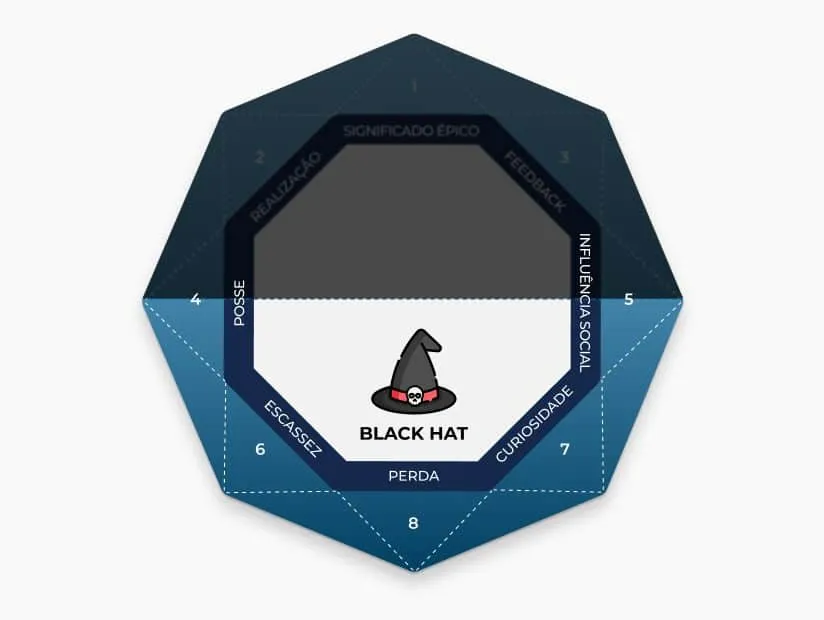
From this observation, the definitions of White Hat gamification and Black Hat gamification were born. Those who are already familiar with the Octalysis Framework know that this method is represented by an octagon containing 8 elements called Core Drives, which govern human motivation.
Yu-kai Chou divides these Core Drives into two categories, which are, precisely, White Hat and Black Hat. In the next paragraphs of this article, you will find out what these concepts are and how they apply in the gamification process.
Contents
- What the White Hat vs Black Hat theory is
- The importance of White Hat and Black Hat in gamification
- Using Black Hat gamification consciously
- The impact of Black Hat on the success (or not) of an endeavor
What the White Hat vs Black Hat theory is
As mentioned at the beginning of the article, the White Hat vs Black Hat gamification theory was born from a curiosity of Yu-kai Chou’s: why do some games succeed, hook their players for a while, and soon afterward suffer a drop in popularity? And why do others manage to maintain a legacy and a consistent player base over the years?
Studying it more deeply, Chou realized that the main reason lay in how these games were designed and in the Core Drives that motivated their players during the more advanced stages of the game.
While the games that go viral and then “disappear” offer only Core Drives that motivate based on feelings such as urgency, obsession, and addiction, those with a more consistent track record tend to give players a continuous sense of well-being and satisfaction.

Images: Catarinas Design
This realization reminded Chou of two concepts he had learned while immersed in the field of SEO (Search Engine Optimization): White Hat and Black Hat.
In the SEO world, a White Hat technique consists of building a website in the way recommended and desired by search engines. The term Black Hat, on the other hand, refers to methodologies that search engines dishonestly, taking advantage of flaws in those platforms to boost site rankings more quickly.
Search engines do everything within their reach to block sites that practice Black Hat SEO, improving their algorithms to identify and remove such pages from their search results. However, the human brain does not work the same way.
Things that stir up feelings of obsession, worry, and even stress end up being seductive and driving us, even if unconsciously. Black Hat gamification takes advantage of this kind of motivation. Even so, a Black Hat strategy can be welcome at certain moments in a gamified context.
The importance of White Hat and Black Hat in gamification
White Hat Core Drives are what Yu-kai Chou describes as motivating elements that make us feel powerful and satisfied, with total control over our lives and actions. Black Hat Core Drives, in turn, are defined by him as those that make us obsessed, anxious, and stressed. While they have a high power to motivate our actions, in the long run they can leave us with a sense of lack of control over our own behavior.
A superficial reading quickly leads one to believe that White Hat gamification is the best option in every way. However, it has an important weak point: it is a strategy that fails to create a sense of urgency.
Black Hat gamification helps create the urgency that is often needed for the gamified system to really work. If a company implements gamification based solely on White Hat in an environment where users are constantly bombarded by Black Hat stimuli, they will probably lack a sense of urgency and keep procrastinating, which harms the experience. For that reason, balance between the two types of gamification is usually a necessary way out.
Using Black Hat gamification consciously
What Yu-kai Chou always makes a point of clarifying is that Black Hat gamification is not necessarily a synonym for bad or unethical. Some people use Black Hat techniques to drive the achievement of their medium- and long-term goals, for example.
Black Hat techniques, when well developed and applied, lead us to take certain actions quickly and without feeling 100% in control of everything. Whether that is good or bad depends on the intentions and the final result of those actions.
That is why it is important to keep an important lesson in mind: when we talk about gamification, it is essential to ensure, above all, that users feel good about being part of that experience. In other words, with good doses of White Hat techniques.
The impact of Black Hat on the success (or not) of an endeavor
Yu-kai Chou’s theories about White Hat and Black Hat gamification are so strong that they can even serve as a basis for predicting whether something will be a success or not. A case study used by the author himself in the book he published on the subject is that of the game company Zynga, the corporation behind FarmVille.

Although it does not officially use the term, Zynga is an expert in the use of Black Hat gamification techniques, which always produced good results at first glance. However, the company suffered from a crucial problem: its games were addictive, but failed to make their players feel, precisely what White Hat techniques.
The result? As users kept playing, the novelty and the enthusiasm of the beginning faded more and more. In addition, the company’s new releases failed to achieve the expected results.
This case illustrates very well the importance of a good understanding of both White Hat and Black Hat. By knowing both fronts in depth, it becomes easier to measure results in advance and implement a gamified system more safely, with less risk of failure.
The need for balance we mentioned earlier proves important once again. If a gamification strategy is shaped without any Black Hat technique, there will probably be no viral success. But if there is no White Hat technique either, users will soon grow tired and abandon the game in search of something better.
Reference:
White Hat vs Black Hat Gamification in the Octalysis Framework