
Board games have been part of people’s lives since ancient times. Senet, the oldest board game ever recorded, traces its origin to the year 3100 BC, during the First Dynasty of the Egyptian pharaohs.
Over time, games evolved along with humanity. Today they are used as a form of entertainment and also serve as a tool for learning, training, and development.

The relationship between board games and education is an old one. Monopoly (also known in Brazil as Banco Imobiliário), for example, was initially conceived as an educational tool. Its creator, the American game designer Lizzie Magie, developed it in the early 1900s with the intention of teaching about Georgism, an old economic doctrine she followed. Over the years, Monopoly changed and lost its original purpose. The version we know today began to be sold in the 1930s is one of the most popular games in the world, having sold 275 million copies by 2015.
However, the changes Monopoly underwent over the years did not completely eliminate its educational value. The game is still able to teach and exemplify concepts and processes relevant to business, such as ROI and, of course, the art of negotiating.
Learning through board games can be so effective that it has even been used in the most critical moments. Chester W. Nimitz, Commander in Chief of the U.S. Pacific Fleet during World War II, went so far as to say that games played an important role in the army’s tactical and strategic preparation before and during the war.
In this article, we will take a closer look at the use of board games in business education. Take your seat on the team and explore this universe with us.
Contents
- Learning to see the big picture
- Mapping investments
- Understanding the particulars of trade-offs
- Beyond Monopoly: other board games and the business skills each one teaches
Learning to see the big picture
A game board is like a great overview, the whole, the setting where the action will unfold. No detail is there by chance, and reading them well is essential to the player’s performance.
In the corporate world, it is not uncommon to find professionals who isolate themselves in their own cocoons, do not interact, do not see what is happening in the rest of the company, and much less understand the impact their actions may have on others. It is a risky behavior, especially for those in management and leadership roles.
In scenarios like this, a dynamic based on board games can be an efficient way to develop broader and even more empathetic perspectives within the team.
Mapping investments
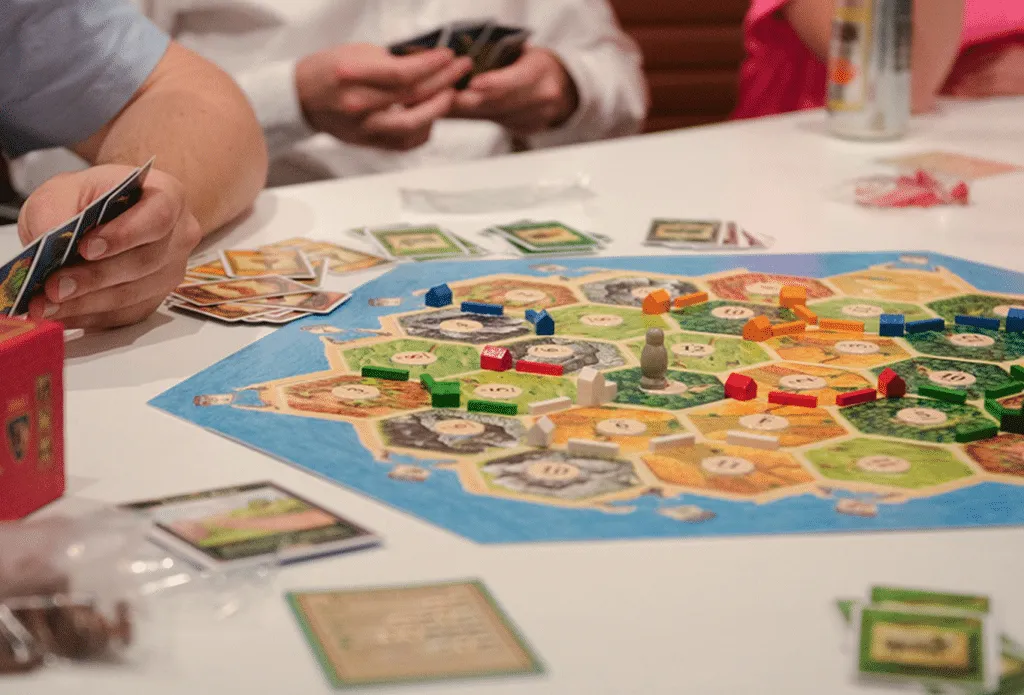
In most board games, we can observe a complex chain of relationships and unpredictable events very similar to the one that exists in the business market.
Let’s go back to the game we mentioned in the introduction of this text, Monopoly. When a Monopoly player buys, for example, a hotel, instead of waiting months to start getting some return on the investment (as would happen in the real world), the player starts making a profit as soon as another participant lands their piece on the space where the property is located. This situation is a clear illustration of the relationship between investing and profiting from the investment.
Other games also work with the idea of investing in assets and receiving a reward later for that investment. In Catan, for example, the player must collect resources (represented by cards) to build roads and settlements. Later, several of those cards can be traded for items the participant wants, in yet another great example of ROI (return on investment).
Understanding the particulars of trade-offs

Within a company, limits on time and money are common obstacles when obtaining resources. For this reason, many businesses resort to the practice of the trade-off, which consists of choosing one thing at the expense of another. Knowing how to make trade-offs intelligently is usually a valued skill in roles such as leadership, supervision, and sales.
This process is constantly emulated by board games. In a game of chess, for example, a player may have to trade a pawn for a better position on the board or, in more extreme cases, give up a valuable piece (the queen, for example) to protect the king.
In both a game and corporate situations, each decision must be seen and analyzed from every possible angle before it is made. However, in both contexts, the lesson taught is the same: at some point, a trade-off will have to be made regardless of the decision maker’s wishes.
Beyond Monopoly: other board games and the business skills each one teaches
Monopoly, the game we covered at the beginning of our text, is undoubtedly one of the first that comes to mind when we think about the relationship between board games and entrepreneurship. But it is not the only one.

Imagem & Ação, the Brazilian adaptation of the popular American game Pictionary, for example, helps develop two skills highly valued in the business world: analytical and observational ability, creativity, and empathy.
In Forbidden Island, on the other hand, the four players must team up to fight not against each other, but against the game itself. Each has a specific role with their own set of abilities, but must also accept help from the others to reach the best decision for the group. If everyone works together, victory is very likely. But if the team is not in sync to collect all the treasures before the island is taken by the waters, everyone ends up losing. A basic and fun lesson in how to work as a team.
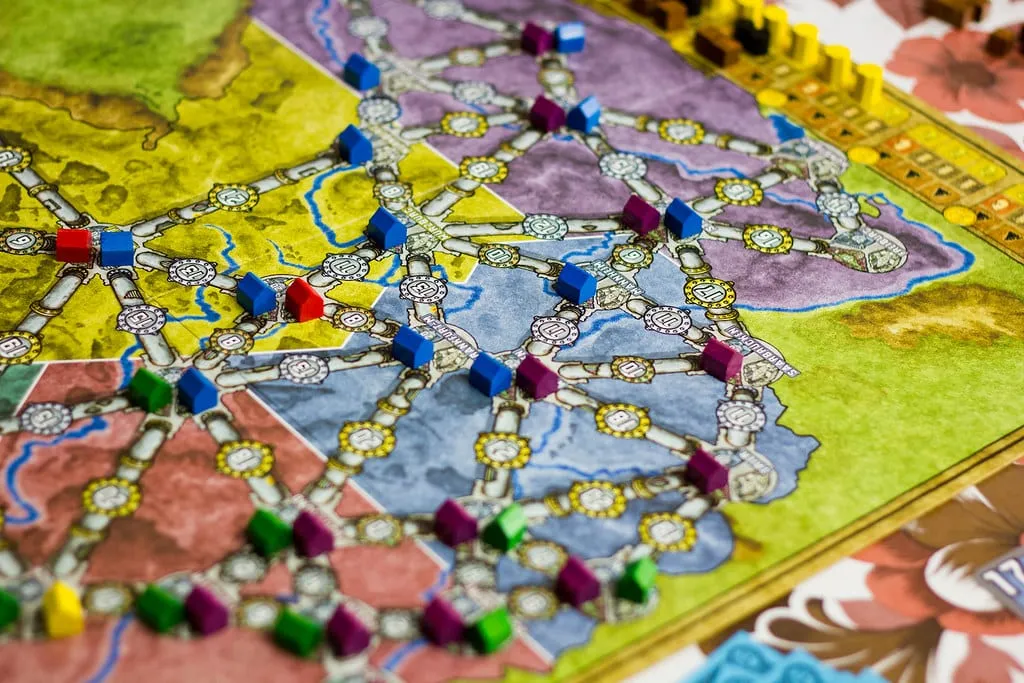
Power Grid is another board game directly inspired by the business world. Its goal is for the player to manage an electric power plant, balancing the maintenance of existing infrastructure with investment in new and more efficient technologies, a challenge common to most ventures.
Cranium, in turn, does not have a premise directly tied to business, but it also teaches us a lesson by showing that everyone has their strengths and can contribute to the whole. A message similar to that of Trivial Pursuit, a game that exemplifies how valuable it is to have a team that is diverse in terms of views and knowledge.
As you could see, board games are much more than a simple way to chase away boredom on a rainy night with friends. Through them, it is possible to learn about complex topics and develop skills highly sought after in the business world.
In addition, board games are a versatile tool. It is even possible to develop custom games for each company’s needs. If the organization identifies the need to improve its employees’ proactivity, for example, it can create a game focused on that skill.
And you, have you ever learned about business through board games? Share your perspective with us.