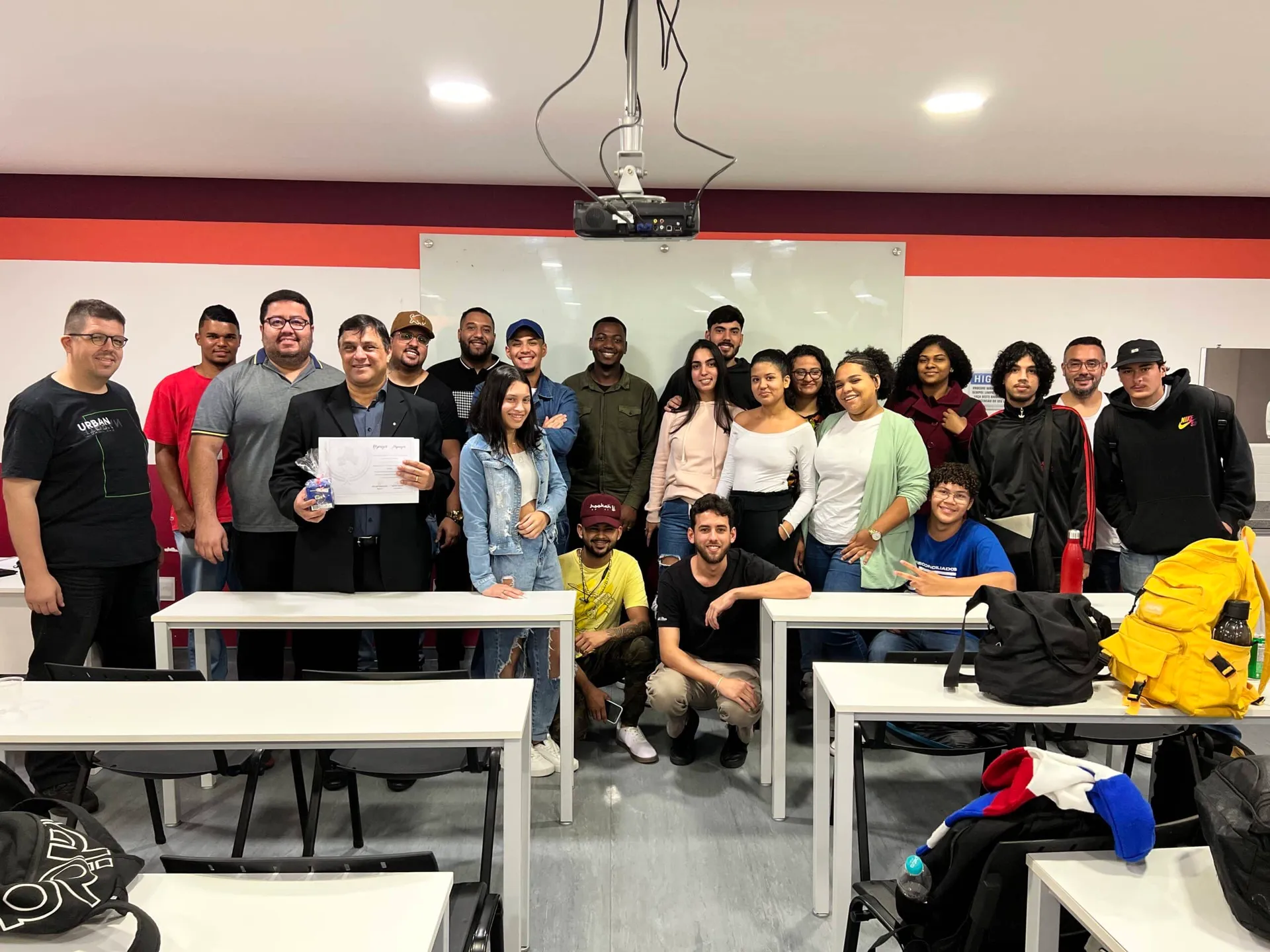
What is the importance of certifications? Last Wednesday (29th), it was time to answer this question in Fapuga’s lecture series, and the person who took charge of preparing the answer was Claudio Scheidt Guimarães. Keep reading to find out how the talk went, and to understand for yourself why institutional certifications are so important.
Claudio Scheidt Guimarães is a university professor in the field of Business Management, with experience at various higher education institutions. He is also a specialist in Geotechnologies in Environmental Management Planning, Smart City, Sustainable University, and the UN’s 17 SDGs. And, in addition to being CEO and President of the company GeoScheidt Científica, Claudio is a Trusted Collaborator of MEC/INEP (Brazil’s Ministry of Education and its national education research institute) – ENADE Commission.
In the talk, Claudio considered the importance of certifications on the world stage, to meet the demands related to Smart and Sustainable Cities, Smart Hospitals, ESG (Environmental, Social and Governance) with the Management System, and other challenges of administration 5.0.
Management systems, accreditation, and certifications were covered. Among them: ISO 9.001, ISO 14001, ISO 14064, OHSAS 18001. Also covered were new technologies, such as QR Code, RFID, medication traceability, and Solid Waste Management.
The importance of certifications today
Certifications are fundamental to the survival and growth of companies today. They work as a seal of quality, attesting that the organization follows best practices in its areas of activity. In addition, certifications can be a competitive advantage, making the company more attractive to the market and increasing customer trust.
But the conversation did not stop at the definition of certifications and new technologies. Claudio Scheidt took the opportunity to encourage Fapuga students to take part in the opportunities that come up for their professional development and integration into the market, such as attending conferences, engaging in Scientific Research (Iniciação Científica), and making the most of technical visits whenever possible.

Speaking about how the event helps bring students closer to the job market, Claudio comments that:
“Our students’ projects are directly related to Socio-Environmental Responsibility, closely tied to the duties and obligations of individuals and organizations to take a voluntary stance in contributing to a fairer society, one that can bring mutual benefits, improving people’s quality of life.”
In other words, understanding the importance of certifications and new technologies also means understanding one’s own role to be played as a professional and as a citizen who is part of a community and a country, and whose actions have impacts on the planet, whether on a larger or smaller scale.
This is because new technologies and certifications, contrary to what one might imagine, do not serve only to attest that a company has quality because it follows certain parameters.
Certification that is not limited to company status
Of course, meeting certain socio-environmental and technological parameters benefits a company’s status. But meeting them because they are a real value of the company, which notices the needs of the context it is part of, makes an institution’s actions much more solid and truly important. As Claudio puts it:
“We urgently need to invest in the qualification of new professionals and prepare them for the global challenge. We need to understand more broadly the speed and breadth of this new revolution and the partnership among government, companies, hospitals, universities, innovative professionals, and civil society.”
In this way, bringing topics such as the importance of certification and new technologies into the college has an embryonic effect on the minds of students who are training to become administrators and hospital managers, to be agents of real action in the socio-environmental and technological spheres, which need to be increasingly connected to market reality.

Some of the most important certifications
One of the certifications most sought after by companies is ISO 9001, which attests to the quality of the organization’s quality management system. Obtaining this certification can bring several benefits, such as improved process efficiency, cost reduction, increased customer satisfaction, and the possibility of entering new markets.
Other relevant certifications include ISO 14001 (environmental management), OHSAS 18001 (occupational health and safety), and ISO 27001 (information security).
In addition to the benefits mentioned above, certifications may also be required by customers or by the government in certain sectors, such as food and beverages. A lack of certification can lead to lost contracts or to fines and sanctions.
Finally, it is important to stress that certifications do not guarantee a company’s success, but they contribute to it. The company needs to have a strategic vision and be committed to quality and continuous improvement to succeed in the market. Certifications are a way of demonstrating that commitment and improving the company’s image in an increasingly competitive market.