
What I can say is that the method that uses gamification applied to business makes the experience of the college student and future entrepreneur complete, because it lets them sharpen their hard skills and soft skills by playing, whether on a console, a PC, or a phone.
Looking at the historical context, there is no longer the situation in which the professor is the owner of knowledge and the undergraduate is just someone who follows the indicated steps. Today, that management student is active and the professor is just a facilitator in the system.
But have you ever stopped to think about the main advantages of the game-based learning methodology in higher education, which uses games to sharpen undergraduates’ behavioral skills and technical competencies?
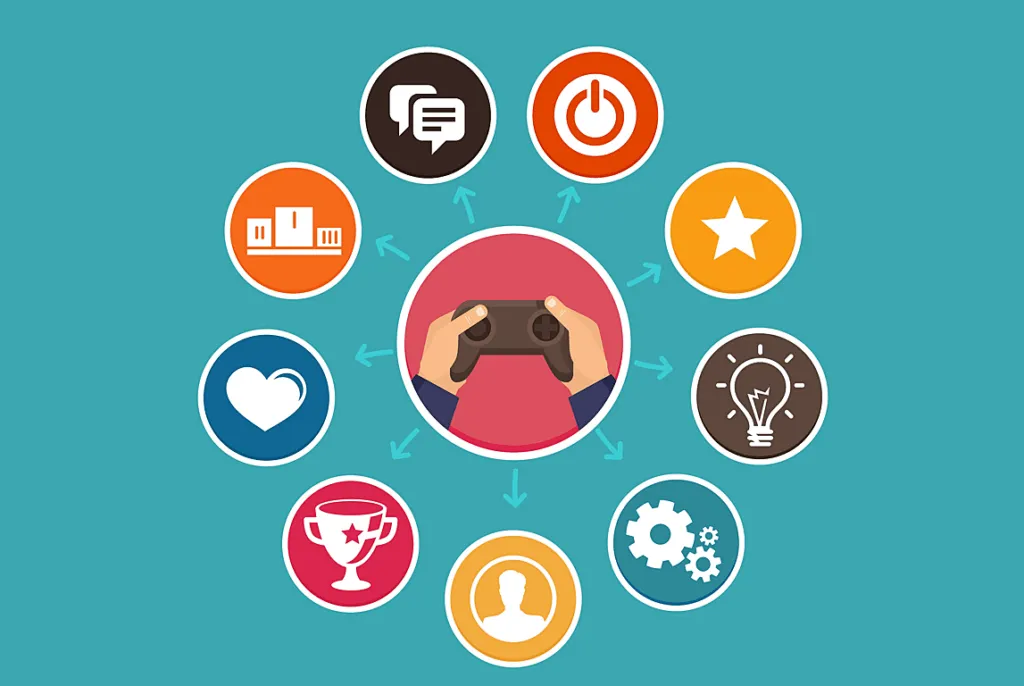
The benefits of gamification applied to business
Gamification applied to business in management studies is based on the use of digital elements to create contexts related to games. For example, avatars, challenges, missions, rankings, prizes, bonuses, and much more.
1 – Sharpening behavioral skills
Using games in management higher education is positive because it allows college students to sharpen skills such as interactivity, creativity, logical thinking, sense of urgency, discipline, and others that are important for a manager.

In games there is an idea of synthesis, which is to join forces and several soft skills to overcome one or more challenges. These challenges, which require multiple competencies to solve, are essential to train a manager who knows how to run a business successfully.
2 – Sharpening technical competencies
Just as games allow undergraduates to improve their behavioral skills, they also have a positive effect on technical competencies, since they help sharpen items such as leadership and the ability to make important decisions.

Besides allowing improvement in a less tiring way, gamification applied to business carries the idea of “learning endlessly.” After all, players go through missions in each new level, becoming experts at solving problems.
3 – Encouraging innovation and new technologies, such as AI
Gamification in college allows undergraduates to work early on with the new technologies that exist in the market. For example, AI (Artificial Intelligence), a very current topic that enables better strategies and more efficient management by the professional.

Even if it isn’t noticeable at first, consider the creation of a game based on cascading information theory. What is that? It is the need for players to unlock information continuously and receive rewards for it.
4 – Solving problems through quick thinking
In the management school that uses games as a method, future managers are connected to an online world that demands solving problems quickly, making it possible to “simulate” reality in the corporate world.

Portrait of young smiling woman holding marker pen while standing by flip chart in office
5 – Measuring the college student’s performance
With the game-based learning method in college, students can get a more accurate idea of which hard skills and soft skills they need to sharpen. Likewise, they will know how their development went. After all, games have goals, progress, and achievements.

For example, progression lets undergraduates see their success in a simple, gradual way. This is because there are levels, which are unlocked as missions are completed successfully.
Gamification applied to business in management studies works!
MIT (Massachusetts Institute of Technology) is one of the educational institutions that use gamification in its higher education courses. About students’ learning from the method, it says:
“Players regularly exhibit presence, decision-making, attention to detail, and problem-solving. All of these behaviors are regularly demonstrated at the school The Education Arcade”.